Hotel of Bees collapse and Werner trapped
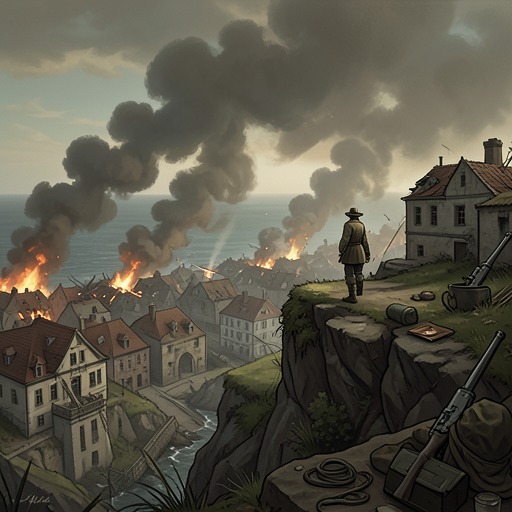
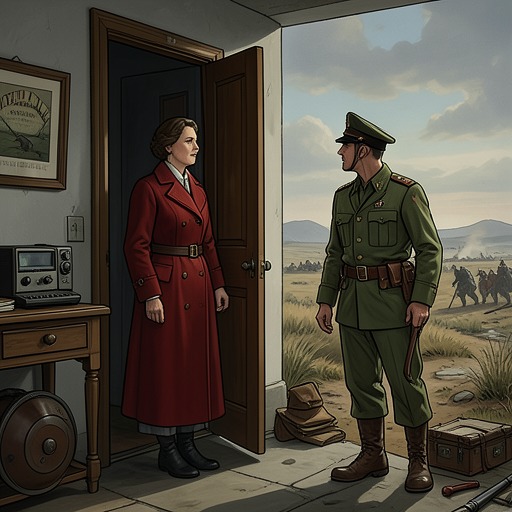
All the Light We Cannot SeeThe collapse of the Hotel of Bees anti-aircraft strongpoint turns Werner Pfennig’s technical skill into a means of enduring confinement: beneath the rubble, he repairs a transceiver while Frank Volkheimer and Walter Bernd wait with him. The days bring dwindling supplies and Bernd’s death, but the repaired radio eventually carries a girl’s voice through the static, opening a connection beyond the wreckage.
Setting and Circumstances
In April 1944, Werner’s unit arrives in Vienna, a city marked by empty windows and disruption. Werner imagines Dr. Hauptmann’s earlier life there as one of scientific conversation in lively cafés, a sharp contrast with the damaged city he encounters. The commander is unavailable, and Frank Volkheimer is told of reports of resistance broadcasts in Leopoldstadt. The men drive around the district in cold fog. This episode places Werner within a military search for illicit transmissions before the later crisis at the Hotel of Bees anti-aircraft strongpoint; it does not establish that the Vienna assignment caused the collapse or the entrapment.
When the hotel lies in ruins, Werner, Frank Volkheimer, and Walter Bernd are trapped beneath it. Werner’s later attempts to receive a signal make the obstacle plain: the rubble may be too deep, the building may be blocking transmission, or the radio may still have a fault. The confinement is measured in immediate practical limits. The men have a field light and a small supply of water, and the prospect of keeping the light working becomes part of Werner’s effort to keep the radio usable. The narrative does not offer a clear view of the destruction from outside; it holds close to what the men can do under the debris.
The Men Beneath the Rubble
Bernd’s condition shifts unexpectedly. After murmuring incoherently for an hour, he falls silent, then sits up and asks for light. The men give him the last water in their first canteen. His brief return to speech turns toward a memory from leave: he had visited his elderly father, who repeatedly told him that he could leave if he wished, though he wanted him to stay. Bernd did leave. He remembered going down into the street with nowhere to go and no friends to meet, after travelling all day to see his father.
The memory ends without reconciliation. In the darkness, Frank Volkheimer switches off the light, and Werner senses how much the story holds back. Bernd becomes quiet again. Frank Volkheimer settles him on the floor and covers him with Werner’s blanket; not long afterward, Bernd dies. His recollection gives the death an intimate measure: alongside the immediate deprivation under the hotel, it discloses a regret that cannot now be answered. The account stays with what the men say and do, rather than enlarging the moment with an explanation of Bernd’s unspoken feelings.
Werner’s Work on the Radio
Werner turns to the damaged equipment. He gathers a small hammer, jars of screws, and electrical cord from a broken desk lamp. In a warped drawer he finds an eleven-volt zinc-carbon battery, marked with a black cat and an American slogan promising nine lives. The battery still holds a charge. Werner thinks of it as a reserve for when the field light’s battery fails, linking the work on the radio to the practical problem of preserving light in the confined space.
He rights a capsized table and places the crushed transceiver on it. At first he is unsure the equipment can be made useful. Working gives him a problem to solve while hunger, thirst, his impaired hearing, Bernd’s death, and thoughts of people elsewhere crowd his attention. He tries to keep his mind on the components: antenna, tuner, capacitor. The effort is not presented as a guaranteed escape; it is a task that can briefly order his attention when the circumstances offer little control.
Later, Werner threads the antenna through the broken ceiling and touches it to a twisted pipe. He carries it around the cellar, trying different positions, then presses the headset to his good ear and moves the tuning needle across the coil. The result is only static. He considers several possibilities: the men may be buried too deep, the hotel’s rubble may obstruct the signal, or some part of the radio may still be broken. These are possibilities, not confirmed explanations. The uncertainty keeps the radio’s failure from becoming a settled verdict: Werner cannot know from the cellar whether the silence belongs to the equipment, the building, or the distance between them.
A Voice Through the Static
On the morning of Werner’s fourth day trapped beneath what remains of the hotel, he is listening to the repaired transceiver and adjusting its tuning when a girl’s voice reaches his good ear. He initially suspects hunger, fever, or his own mind imposing a pattern on static. The voice continues in quiet, precisely enunciated French, reading from Twenty Thousand Leagues Under the Sea. Its arrival answers none of Werner’s questions about the rubble or the fate of the outside world, but it changes the meaning of his work: the radio is not only an object to repair or a distraction from confinement; it has brought another person’s words into it.
The sequence holds two forms of isolation together. Bernd’s memory concerns a departure from a father whose invitation he did not accept; beneath the hotel, the living men cannot leave at all. Werner’s patient efforts with salvaged parts do not undo either loss, but the voice that reaches him establishes a fragile link across the distance. The transmission’s significance lies in that limited achievement: after days of confinement and failed reception, the repaired set carries a human voice where Werner had heard only static.